Beloved Aliens Among Us

by Columbia Hillen
If there was one thing I liked about Steven Spielberg’s latest movie, Disclosure Day, it was the last word: ‘Listen.’

I’d have given Spielberg some credit if, at the end, when the ‘mysterious character’ is brought in, it would have been a giant Horsetail. After all, he’s been around for 400 million years.
Not just because I’m such a herbie, which, ok, I am, but because I believe we know as little about plants as we know about Aliens. And their language is just as mysterious and complex. In my view, those people who do understand this language, experience a radical transformation, their brain is rewired. I’m still at ‘hello,’ but there’s no turning back for me, I feel incomplete if I’m not around a herb every day. So far, I hardly know anything, but I know I want to know more.
Our gut and our bones remember this language before we do. For those who open their plates and cups to herbs, their microbiome changes, not only physically but energetically. Those millions of friendly bacteria living on, and with us, start making healthier food decisions. They remember a time when we, humans, were part of Nature, living in harmony with the seasons, with our senses.
The marketing campaign for Disclosure Day was loud so many thought it must be good, merely because it was loud. Sadly, our lives are moving in this direction. Everything is getting louder in life and we get carried away believing if something is loud, it must be good.

Some people are so used to loudness all the time, they panic in silence. They need, or they think they need, outside noise - for others to tell them how they feel, what they like, what they should eat, whom to love. In silence they’d have to face themselves, whom they’ve come to fear as the Alien.
If they only tried silence with plants…
Plants are loud but in a quiet, subtle way, if we’d only switch off outside noise and open our hearts to listen.
My first memory of plant voices was a chorus of Pines and Firs in the mountains of Transylvania where I grew up. My parents were geologists, and my sister and I spent summers in the mountains, feeding on Wild Strawberries until our tummies ached, paddling in cold springs, baking potatoes sprinkled with Wild Thyme on open fires in the long evenings.
I remember one day we stopped for lunch at over 1,000 m altitude where we had a clear view over the forest. I noticed how the tree-tops seemed to move as if in unison, offering their cones as candles to be lighted, all the while whistling a sea chanty, a relaxing rendition of soft summer waves. I swear I could smell salt in the air even though I was a full day’s drive from the coast. Was it their way of telling me one day I would live by the ocean?
Some might say it was simply the wind playing tricks on me. But I sensed even then it was a tree song for I have often listened to trees in northwest Ireland where I now live and the songs of the Sycamore and the Oak and the Beech are all different even though it’s the same wind blowing through them.

I grew up with plants, at a time when there were no contraindications. My grandmother followed the aural herbal school handed down by her ancestors. The Mugwort, St. John’s Wort and Yarrow were the doctors she called upon to deal with our ailments. For me then, bitter teas tasted of goodness, of love and care, especially when I indulged in too many pancakes. Wild Thyme tea brought family and friends together. Lovage smelled of holidays and celebrations when added to roasts in the oven.
I was lucky having the voices of plants play such an integral role in my childhood and now, as a herbal practitioner I continue to listen to their wisdom.
The simple act of adding a little Thyme, Rosemary, Sage, even Plantain and Mallow leaves or powdered Alexander seeds in food, opens channels of communication headquartered in the gut. This act starts calling for extra greens, or protests about too much sugar. Or you may find yourself drinking a bitter as a digestive and before you know it, plant vitality is dancing all around your arteries and your cells are singing.
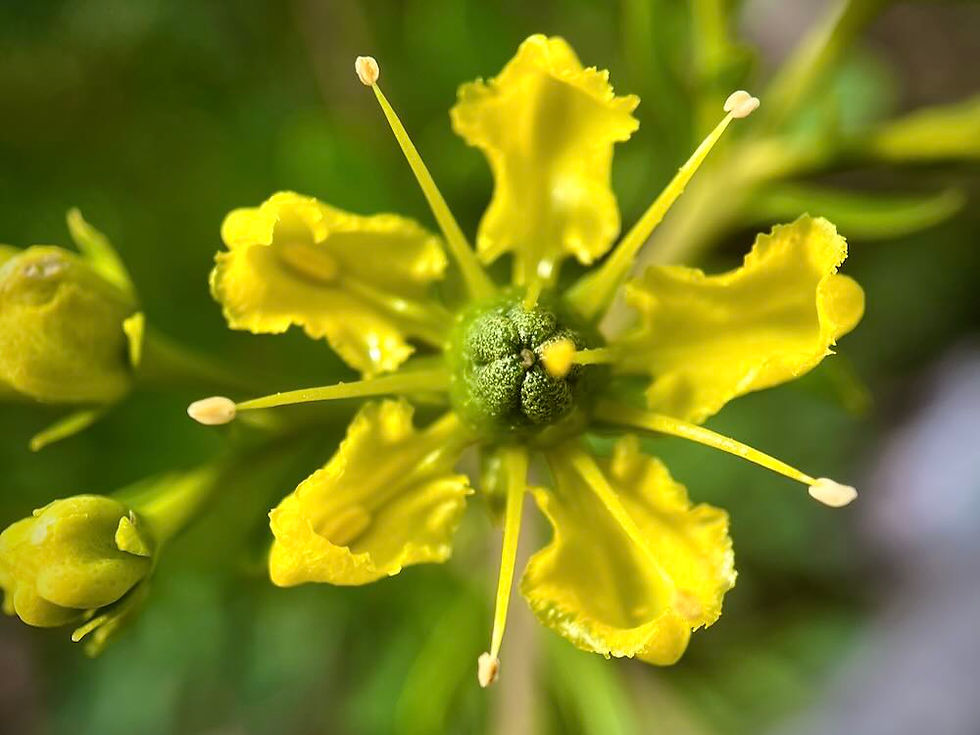
As a firm believer of food as medicine, this is where I enjoy plant voices most. The cacophony that erupts when I walk into my garden looking for help for lunch and dinner is as loud as a courtyard full of puppies. So instead of one herb, I end up with a basketful as I don’t like to disappoint them. So Calendula and Thyme go into my savoury shortbread; Dill and Oregano jump together in my sea spaghetti dish and some Mallow leaves sneak in when I’m not looking; Rosemary and Rose have no problem powdering my madeleines; the Pine and Elderflower decide it was time for a latte and just blitz themselves into a frenzy; and the Ox-eyed daisy… who can say ‘no’ to those smiling eyes, they pretty much live on my plate these days, after the Dandelions and the Plantains have taken a break for summer.
I don’t know about you, but my way of being with plants is by listening. With my fingers, my eyes, my ears and my nose, with my tongue and my heart. I listen when I plant them, when I greet them at every stage of their growth. When I harvest them and when I share them with my clients. I also listen with my gut.

And I learn a lot when I don’t listen. It happened recently when I noticed a certain plant kept returning to my garden every year. She was so modest and patient, she simply wanted to blend in. But in my ignorance I didn’t listen for two years and kept clearing it away, ignoring her gentle ‘Excuse me, can I tell you about me?’ This year something clicked in my gut, a little punch. ‘Will you stop ignoring me and listen?’ And I did. And thus I was introduced to a magnificent Marsh Woundwort with whom I now want to sit with to make up for lost time. She is now free to pop up wherever she wants. And when she blooms, it will be another stage in our conversation as I watch her direct bumble bees to her nectar through the intricate designs on her flowers.
Getting back to Spielberg’s movie, there is a point he tried to make, but failed. Listening brings with it empathy and understanding. I have often observed when we practice listening to plants, we listen better to others - humans, animals and our own thoughts. We begin to understand more, to care more, to see the pain before the question is asked, to take a step back from making noise. Our decisions arise from the silence of listening.

Do we need another race of beings to shout ‘Listen!’? Maybe. Do they need to be from outer space? I don’t think so. Step into the wilderness, gaze at a forest floor, a meadow, a herbalist’s garden. Open your senses, all of them, including the sixth. A multitude of eyes are watching you, filaments follow your every move, they whisper if you touch them, cry if you leave before they’ve told their story.
Sadly, this is ‘alien’ to many people. So to them I say, “Yes, Aliens do live among us.” And if you listen closely, you’ll realise there’s nothing alien whatsoever about them.
It’s simply that much has been lost in translation and we need to find it again. Quickly.
This article was published in the e-Herbalist equinox edition, the official publication of the Association of Master Herbalists.


Comments